Are you buying a “glass door mini fridge” for distribution—and worried the first container will turn into warranty claims, fogged doors, and angry retailers? That usually happens when specs are copied from listings instead of engineered for your market.
Choose a glass door mini fridge by locking the use-case (countertop merchandiser, minibar, or undercounter beverage), then specifying temperature stability, door glass (double-pane/Low-E), certifications (ETL/NSF where required), refrigerant (often R-290/R-600a), and a QC plan that verifies cooling performance, leakage, and packaging durability before shipment.

Most competitor pages focus on “nice features.” You need a procurement system: specs → compliance → QC → spares → margin protection. Here’s the exact approach we use with importers and distributors.
What “Glass Door Mini Fridge” Type Are You Actually Buying?
Are your customers asking for a mini fridge with glass door, but you’re quoting the wrong category—then discovering it can’t hold temperature, can’t vent properly, or doesn’t merchandise the product well? Misclassification is a silent profit killer.
A “glass door mini fridge” usually means one of three products: (1) countertop glass door merchandiser for impulse sales, (2) glass door minibar for hotel rooms, (3) undercounter beverage refrigerator for bar/kitchen builds, or (4) a residential-style beverage cooler commonly sold through e-commerce channels. Choose based on duty cycle, ventilation, and target temperature—not just liters or “can count.”
Map the use-case to the engineering
When you buy wholesale, the “type” determines everything downstream: cooling system, airflow design, glass specification, and compliance requirements.
| Image | Type | Typical Placement | Buyer Priority | Common Capacity | Non-negotiable Spec |
|---|---|---|---|---|---|
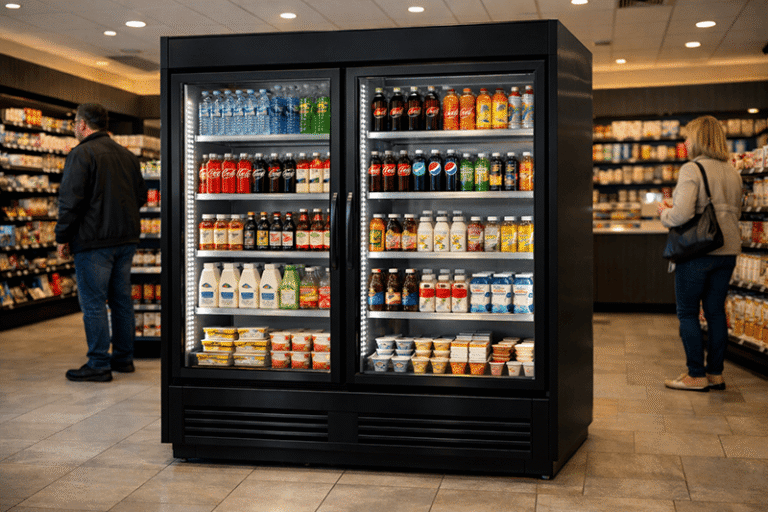
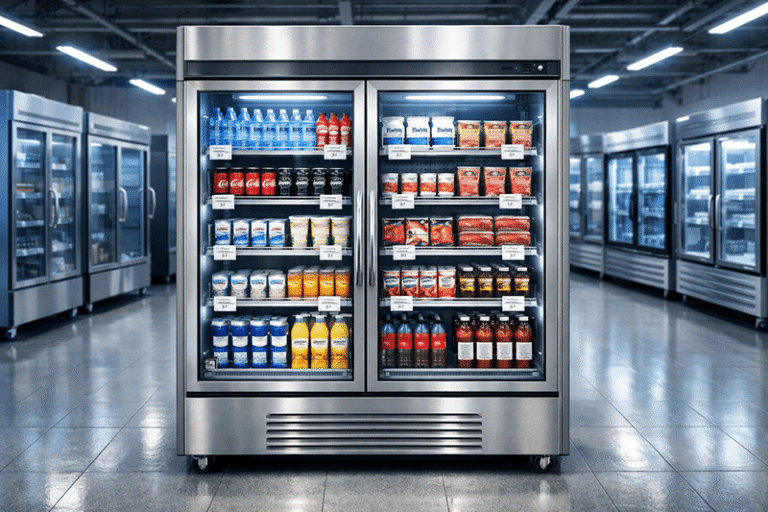
| Countertop glass door refrigerator (mini merchandiser) | POS counter, café, convenience store | Visibility + fast recovery | 12–80 L | Fan-forced airflow + LED + stable 0–10 ℃ (32–50 °F) | |
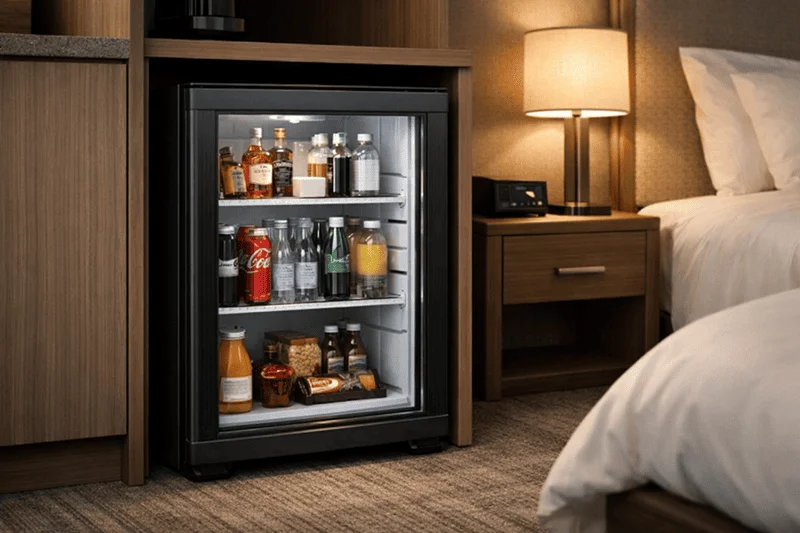
| Glass door minibar fridge | Hotel room | Quiet + low vibration | 20–40 L | Noise target, low power draw, optional thermoelectric (market dependent) | |
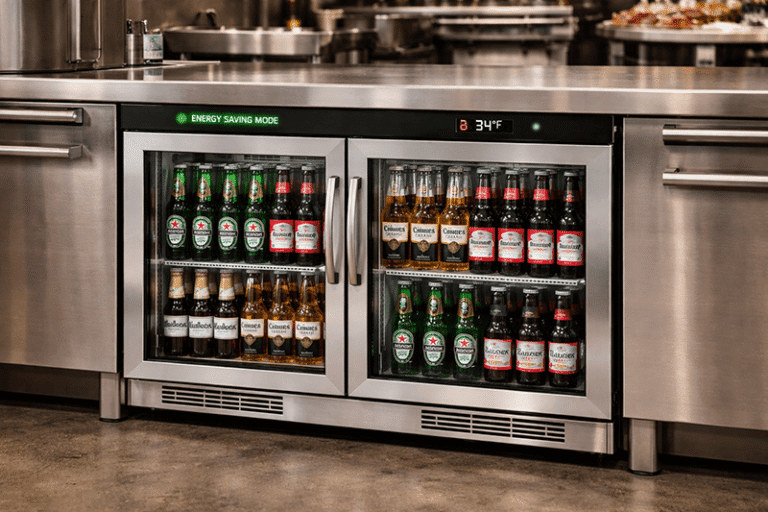
| Undercounter beverage refrigerator (glass door) | Bars, kitchens | Built-in fit + serviceability | 90–150 can class | Front ventilation, accurate controls, consistent pull-down | |
| Residential beverage cooler (e-commerce semantic) | Home, office, dorm, entertainment room | Appearance + low noise + price | 80–150 can class | Freestanding ventilation, basic temperature control, consumer-grade duty cycle |
If your channel is retail and foodservice, you’re typically in countertop merchandising territory—similar to “countertop glass door refrigerators and freezers” categories you see on dealer sites. Those categories emphasize door style, features, and even refrigerant type like R-290/R-600a.
KOLVVI recommendation (B2B reality): don’t start from “liters.” Start from placement + ambient + duty cycle. A unit sitting under direct lighting at checkout behaves very differently than a minibar in a 24 ℃ (75 °F) hotel room.
Which Core Specs Prevent 80% of After-Sales Problems?
Do you keep seeing the same complaints—“not cold enough,” “freezes in the back,” “noisy,” “door sweats,” “shelves bend”? Those are not random. They come from five spec gaps you can prevent upfront.
To reduce returns, specify: (1) real temperature range and stability (not marketing), (2) fan-forced airflow for merchandisers, (3) door gasket and hinge durability, (4) shelf load rating and spacing for your SKU mix, and (5) controller accuracy with a defined sensor placement and calibration rule.
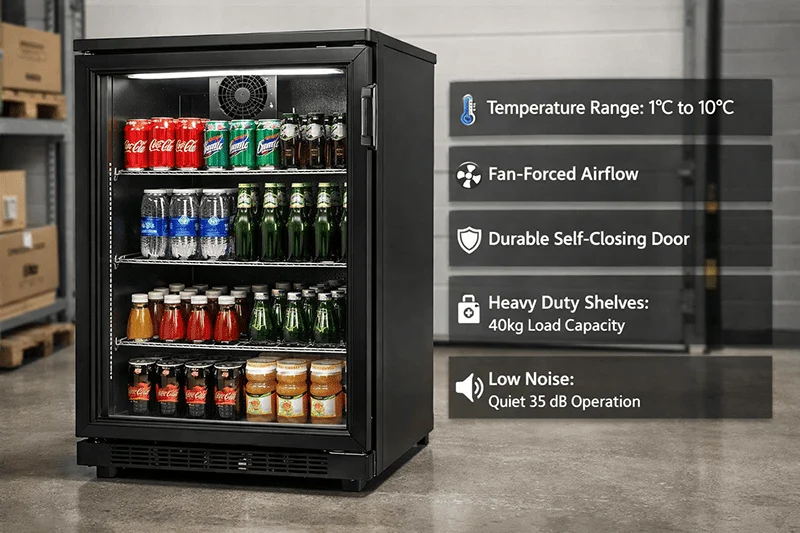
The “spec lock” checklist you should send every factory
Consumer listings love to quote a single number like “34 °F.” Procurement needs test conditions.
| Spec Item | What you should write in your RFQ | Why it matters |
|---|---|---|
| Target temperature | 0–10 ℃ (32–50 °F) or your exact need | Prevents “too warm” disputes; matches beverage vs food needs |
| Ambient rating | e.g., 30 ℃ (86 °F) or 32 ℃ (89.6 °F) | A cooler that works at 24 ℃ can fail at retail front-of-store |
| Cooling method | Compressor + fan-forced (merchandiser) | Thermoelectric struggles under high ambient and frequent door openings |
| Pull-down & recovery | Define time-to-temp with load | Protects you from “it cools eventually” products |
| Shelf load & spacing | e.g., 25 kg per shelf, pitch in mm | Stops shelf sagging and “doesn’t fit bottles/cans” complaints |
| Noise target | dB(A) at 1 m under steady state | Prevents hotel/office rejection |
You’ll notice major sellers highlight temperature ranges and capacity bands in consumer guides, but they don’t teach you how to enforce them with test conditions.
That enforcement is what protects distributor margin.
How Do You Specify the Glass Door to Avoid Fogging and Heat Gain?
Are you getting “fogged glass” photos from retailers? That’s not just cosmetic—fog kills merchandising, reduces impulse sales, and triggers returns. Most buyers under-spec the door because “it’s just glass.”
Use double-pane tempered glass as the baseline, then upgrade to Low-E glass for lower heat gain; add anti-fog heater only when humidity/traffic demands it. Define condensation performance (no persistent fog under stated ambient/RH) and require gasket + door alignment checks in QC.
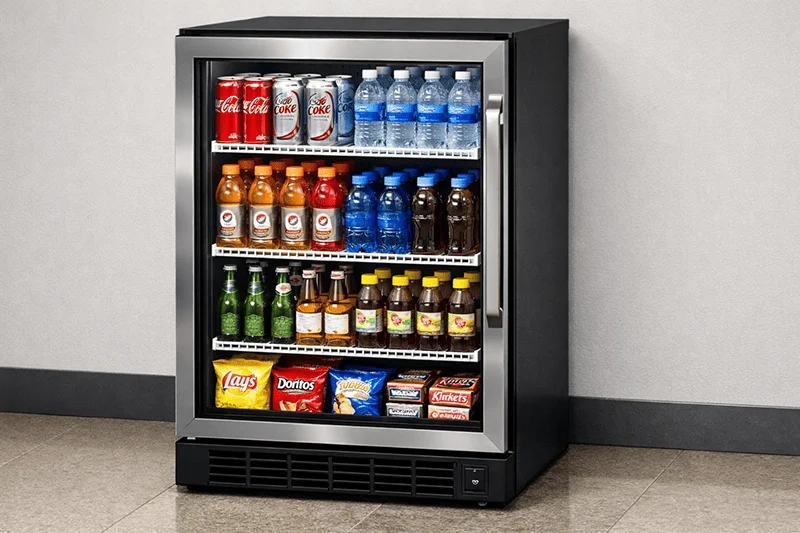
Pick the door stack based on your selling environment
A Best Buy category example even calls out “double-layer” glass to reduce condensation in merchandising contexts.
That direction is correct—but B2B needs the decision rule.
| Environment | Recommended Door | Notes |
|---|---|---|
| Air-conditioned store, moderate humidity | Double-pane tempered glass | Best cost-performance |
| Front-of-store, strong lighting | Double-pane + Low-E | Lower heat gain = better stability, less compressor cycling |
| High humidity / frequent openings | Double-pane + Low-E + anti-fog heater (optional) | Heater improves clarity but increases energy use—spec it only when needed |
Also specify the door hardware: hinge cycle expectation, self-closing behavior (if required), and gasket material. Many “mini display fridge” issues are actually door alignment + gasket compression problems, not cooling-system failures.
What Certifications and Standards Matter in the U.S., EU, and GCC?
Are you importing into the U.S. or supplying chains that demand third-party marks—and you’re unsure what’s truly required vs “nice to have”? Getting this wrong causes border delays, rejected listings, or lost tenders.
For North America, buyers commonly request ETL Listed or equivalent safety certification; for commercial foodservice applications, NSF/ANSI 7 is frequently referenced; energy programs and test methods may apply by category; and refrigerant rules increasingly favor low-GWP options like R-290/R-600a, which are listed by EPA SNAP and used widely in compact commercial units.
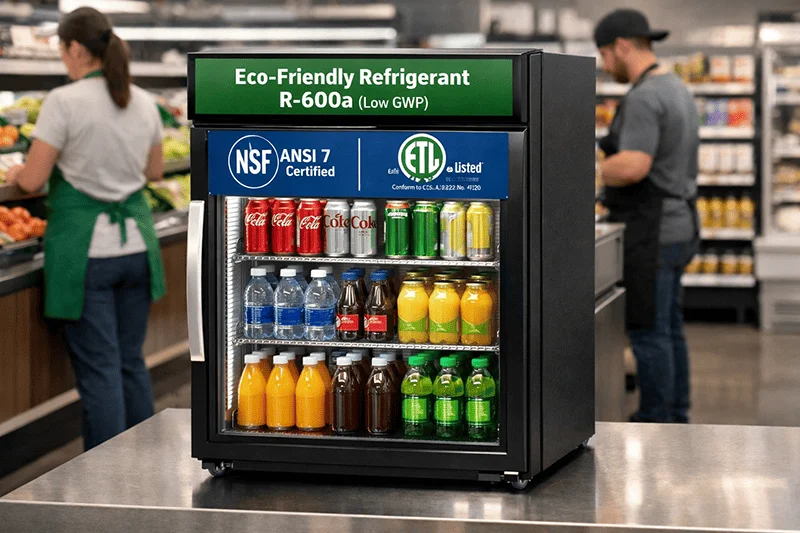
Translate “certification words” into procurement actions
- ETL Listed (Intertek): The ETL Mark indicates product compliance to North American safety standards and is widely accepted by authorities and retailers. See Source
- NSF/ANSI 7 (Commercial Refrigerators & Freezers): Commonly referenced for equipment used to store/display cold food in commercial environments. A high-level overview is here: See Source
- ENERGY STAR (Commercial refrigerators/freezers): ENERGY STAR publishes key product criteria referencing NSF standards and UL safety standards for commercial units. See Source
- Refrigerant compliance (EPA SNAP): EPA SNAP listings include hydrocarbons such as R-290 (propane) and R-600a (isobutane) in relevant contexts; you should align refrigerant choice with destination regulations and labeling. See Source
Many dealer categories now filter by refrigerant type (e.g., R-290, R-600a) and call out eco characteristics in their navigation, because the market is moving that way.
Your procurement move: request the full compliance package (CB report/ETL file where applicable, labels, manuals, wiring diagram) before deposit, not after production.
What OEM/ODM Customization Actually Increases Sell-Through?
Are you customizing for the sake of customization—then realizing it didn’t improve sell-through, but did increase lead time and defect risk? Smart OEM/ODM is about retailer acceptance and channel conversion, not random aesthetics.
High-ROI customization includes: branded lightbox (for countertop merchandisers), optimized shelf spacing for your best-selling SKUs, lock & key for office/retail, localized plug/voltage and language manuals, and packaging engineered for parcel/warehouse handling. Keep cosmetic changes modular to avoid quality drift.
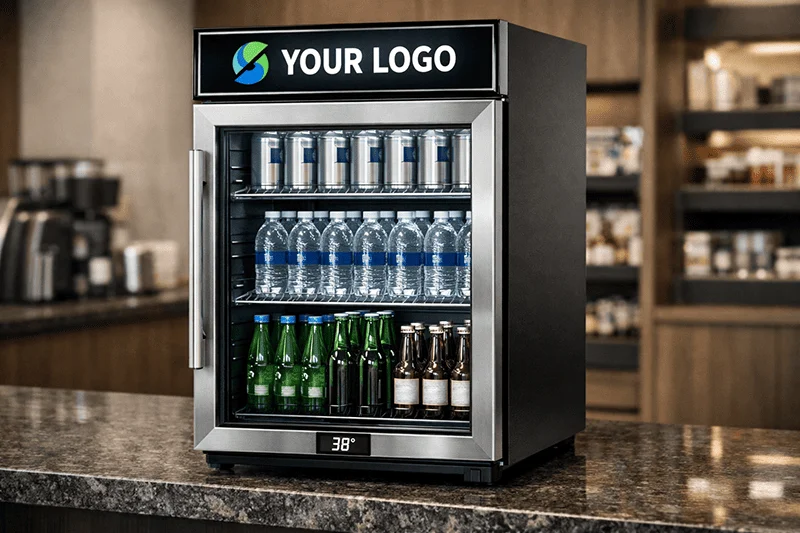
Choose customization that your channel will pay for
A factory-style mini cooler page highlights a key merchandising lever: optional advertising display lightbox for countertop promotion.
That’s exactly the type of OEM feature that distributors can monetize.
| Customization | Best For | What to define in writing |
|---|---|---|
| Top lightbox + logo | Convenience, café, retail | Luminance, film artwork spec, LED lifespan, wiring access |
| LED interior color temp | Premium merchandising | 4000K–6500K preference by market |
| Lock & key | Office, dorm, shared spaces | Lock cylinder spec, spare keys quantity |
| Shelf geometry | Beverage-focused channels | Shelf pitch in mm; bottle/can fit map |
| Color/finish | Chain rollout | Color standard (RAL), scratch resistance expectation |
| Manuals/labels | Compliance + lower support cost | Language set, warning labels, rating plate format |
KOLVVI approach: we push you to standardize 80% of components across model families, then customize the 20% that the market sees (branding + fitment). That protects lead time and spare parts efficiency.
What Factory QC Should You Demand Before Shipment?
Are you relying on “factory QC” without a defined acceptance standard—then discovering issues only after the container arrives? That’s the most expensive place to find defects.
Require a written QC plan: incoming inspection (gaskets, glass, controllers), in-process checks (foam density, wiring, refrigerant charge control), final test (temperature pull-down, leak test, door seal test, noise), and packaging validation (drop/vibration). Tie it to sampling rules and photo/video evidence.
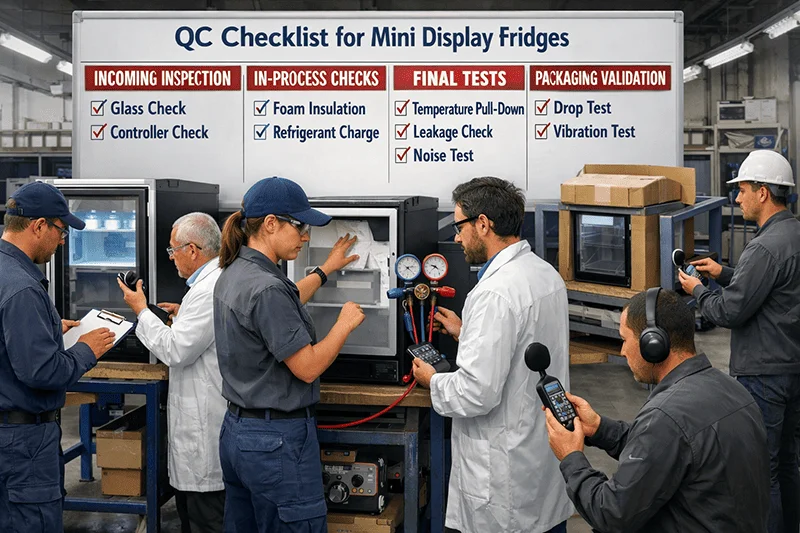
A MECE QC plan (what your inspector should actually do)
| Stage | Test | Pass/Fail definition (example) |
|---|---|---|
| Incoming | Glass inspection | No scratches in A-zone; tempered stamp verified |
| Incoming | Controller verification | Firmware version matches approved; probe reading within tolerance |
| In-process | Door alignment | Even gasket compression; no daylight gaps |
| Final | Pull-down test | Reaches 4 ℃ (39.2 °F) within defined time at defined ambient |
| Final | Leakage test | Verified by standard leak detection procedure |
| Final | Noise | Within your dB(A) target at 1 m |
| Packaging | Drop test | Carton intact; unit functional; door not shifted |
| Packaging | Vibration | No shelf damage, no glass stress marks |
Retailers and dealers emphasize features like LED lighting, door styles, and sometimes certifications such as ETL on product pages—use that as a reminder: the market expects consistency, and consistency comes from QC discipline.
How Do You Plan Logistics, Spares, and Warranty to Protect Margin?
Are you selling a glass door beverage fridge at good margin—then losing it all on spare parts air shipments and labor reimbursements? Warranty is not a policy. It’s a supply chain.
Protect margin by planning: (1) a recommended spares kit per 100 units, (2) modular design across SKUs, (3) service manuals and wiring diagrams in-box, (4) clear DOA vs warranty rules, and (5) container loading plans that reduce freight damage.
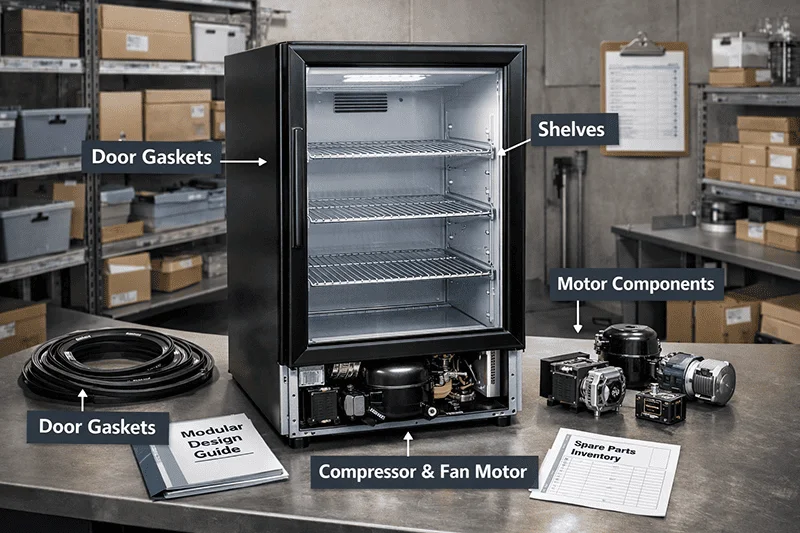
The spare parts list that saves you from panic
Start with the components that fail most often and are cheapest to stock.
| Spares to stock | Why | Typical ratio (guide) |
|---|---|---|
| Door gasket set | Shipping damage, seal issues | Higher ratio |
| Shelves + clips | Handling damage, overload | Medium |
| LED driver/strip | Easy field swap | Medium |
| Controller + probe | Sensor errors, drift | Medium |
| Fan motor (merchandiser) | Continuous duty | Medium |
| Hinge/handle kit | Door misalignment, abuse | Low–medium |
Also ensure your product listing/pack includes what retailers expect: adjustable shelving, visibility, and door performance. Even consumer product pages emphasize the glass door display function and removable shelves—your B2B execution must be better, not equal.
Conclusion
If you want a glass door mini fridge that sells at scale, you must buy it like an engineer: lock the type, lock the door spec, lock compliance, then enforce QC and spares planning. Send KOLVVI your target market, size range, and branding needs—we’ll return a spec sheet + quotation package built for distribution.