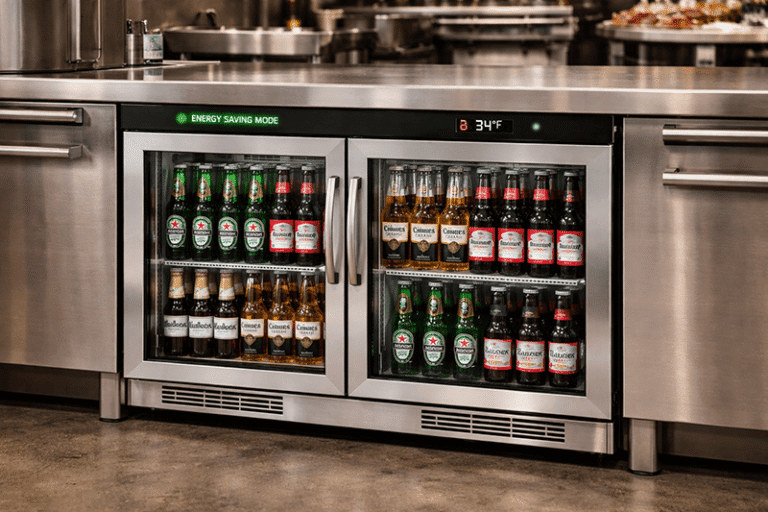
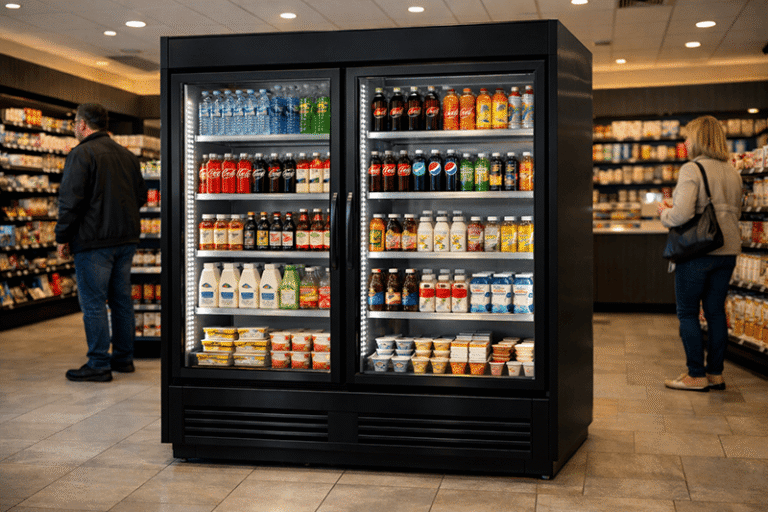
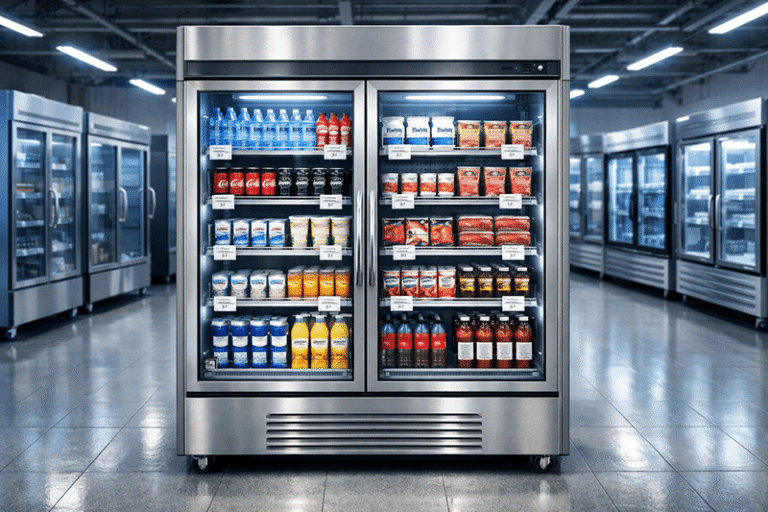
Are you sourcing a “small display fridge” and getting wildly different quotes—some look cheap, then fail temperature, frosting, or certification at the worst time? That confusion creates dead stock, warranty costs, and delayed launches.
You should lock the category (countertop merchandiser vs refrigerated display case), then specify capacity, temperature performance, refrigerant (often R-600a / R-290), voltage/plug, glass & lighting, and required certifications (e.g., NSF/ANSI 7 for foodservice display in the U.S.). A tight RFQ turns vague requests into import-safe, comparable offers.

Most buyers don’t lose money on the unit price—they lose money on the wrong spec. Let’s convert “small glass display fridge” into a spec that manufacturers can build consistently and distributors can sell confidently.
What Counts as a “Small Display Fridge” in Commercial Procurement?
Are you hearing “mini fridge” from the sales team, “countertop display fridge” from the dealer, and “merchandiser refrigerator” from the factory—and everyone thinks they mean the same thing? That mismatch triggers wrong airflow design, wrong defrost logic, and wrong compliance.
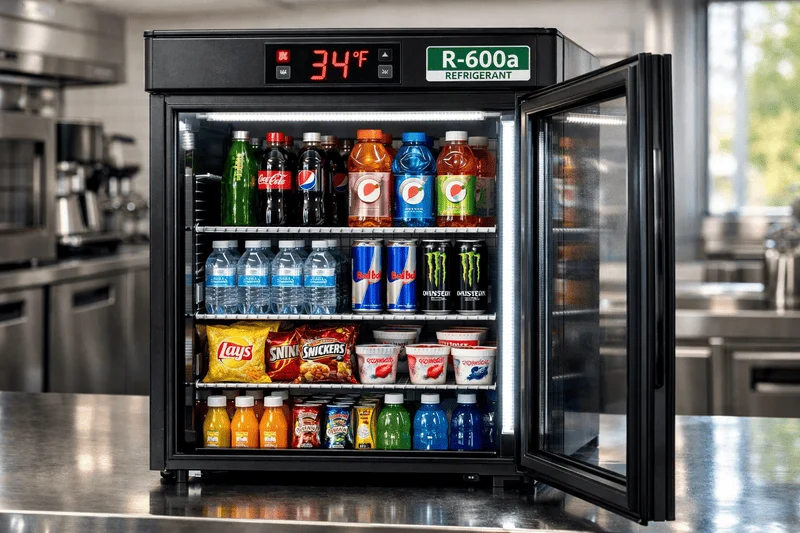
In B2B procurement, a small display fridge usually means a countertop glass door merchandiser (about 1.8–7.0 cu ft) designed to display packaged beverages or snacks at ~33–40 °F (0.5–4.4 °C), with LED lighting, adjustable shelves, and commercial-duty components.
Here is the practical way we classify “small commercial display refrigerators” when you’re importing:
| Image | Category | Typical Use | Key Identifier | Common Risk If Mis-Quoted |
|---|---|---|---|---|
 |
Countertop merchandiser refrigerator | Packaged beverages/snacks | Glass door, forced-air, shelves | Temp instability when over-loaded |
 |
Refrigerated bakery display case | Cakes/pastries | Curved/front glass, wider footprint | Condensation and fogging complaints |
 |
Open-air merchandiser | Grab-and-go | No door, air curtain | Huge energy + poor performance in hot stores |
If you sell beverages at checkout, you likely need a countertop display fridge (aka countertop merchandiser). If you sell pastries with high humidity exposure, you may need a refrigerated display case with a different airflow and glass design.
7 Specs That Decide Whether Your Countertop Display Fridge Sells Fast or Becomes Dead Stock
Are you comparing quotes that list “3.0 cu ft” and “LED” but don’t mention how the unit actually holds temperature, what refrigerant it uses, or whether the glass is commercial-grade? That’s how “cheap” becomes expensive.
Focus on seven import-critical specs: usable capacity (not just gross cu ft), verified temperature range, glass & anti-fog strategy, refrigeration system + refrigerant (often R-600a / R-290), electrical/plug by market, required certifications, and packaging + spare parts plan. These determine sell-through and warranty rate.
Dive deeper:
We recommend you structure your RFQ around measurable, testable requirements—then force every supplier to answer the same fields.
1) Capacity & internal layout (sellable SKU count)
A “3 cu ft” unit can still disappoint if shelf pitch is wrong or internal height is wasted. For example, countertop merchandisers commonly offer adjustable wire shelves and multiple display levels. Web catalog listings often show 1.8–4.1 cu ft in this category, plus higher-end 6+ cu ft countertop models.
- Example: Web listings show compact countertop models from ~1.8 cu ft to 4.1 cu ft, while premium countertop merchandisers can be 6+ cu ft.
(Category examples: WebstaurantStore countertop glass door refrigerators & freezers.)
2) Temperature performance & airflow (what you can safely promise)
Many countertop merchandisers target the low 30s °F for packaged product. For instance, a True countertop merchandiser listing specifies 33–38 °F (0.5–3.3 °C) operating range. If you sell chocolate, dairy, or ready-to-eat food, your allowed temperature swing matters more than headline numbers.
3) Glass, lighting & merchandising (visibility drives impulse sales)
Your “small display fridge” is a marketing tool. Buyers expect:
- LED lighting (top/side)
- Double-pane tempered glass
- Sometimes Low-E multi-pane glass for energy efficiency and reduced condensation
Manufacturers like Hoshizaki highlight energy-efficient Low-E multi-pane glass on glass-door merchandisers, and major brands commonly specify double-pane tempered glass.
4) Refrigeration system & refrigerant choice (compliance + service)
R-600a is common in modern countertop display refrigerators and is frequently specified with low environmental impact figures (low GWP, zero ODP). In product specs and industry references, R600a / R-290 is often cited around GWP 3 and ODP 0.
When you import, ask for:
- Refrigerant type and charge
- Compressor brand/horsepower class
- Service access (back/bottom mounted) and airflow clearance requirements
5) Electrical & plug standards by market (avoid “it doesn’t plug in” disasters)
This is the most avoidable shipment issue.
- U.S. commonly uses 115 V and NEMA 5-15P for countertop units
- EU/UK often require 220–240 V with region plugs (Schuko/UK) and CE/CB compliance
If you plan to stock one model globally, you need electrical variants (power supply, cord set, labeling) to match your target market.
6) Compliance & certifications (sell into your channel)
If your buyers are foodservice operators, certifications are not “nice to have.”
- Many commercial merchandisers reference food equipment standards such as NSF/ANSI 7 for refrigerators/freezers used to store and/or display cold food.
- Safety standards for refrigeration systems and refrigerant classification are commonly aligned with ASHRAE guidance in many markets.
A small display fridge is glass-heavy. Your real margin depends on:
- Drop-test-ready packaging
- Foam density and corner protection
- Spare parts kit (door gasket, LED driver, controller, fan motor)
- Clear troubleshooting manual (for distributors and service partners)
Use this RFQ mini-table to force supplier clarity:
| RFQ Field | Your Target | Supplier Must Provide |
|---|---|---|
| Temperature range | e.g., 33–40 °F (0.5–4.4 °C) | Test condition + controller model |
| Refrigerant | e.g., R134a / R600a / R-290 | Charge amount, labeling, safety notes |
| Glass spec | Double-pane / Low-E option | Glass thickness, door heater (if any) |
| Voltage/plug | 115 V NEMA 5-15P / 220–240 V | Cord length, plug type, nameplate |
| Certifications | NSF/ANSI 7 / CE/CB/ETL (by market) | Certificates + factory audit support |
| Packaging | Export carton + pallet | ISTA approach, drop test evidence |
| Spares | 1–2% suggested | Parts list, pricing, lead time |
Small Display Fridge vs Refrigerated Display Case: Which One Should You Quote?
Are your customers asking for a “small display refrigerator for cakes” but you quote a beverage merchandiser? Or they want bottled drinks at checkout and you quote a curved-glass bakery case? That mismatch kills conversion.
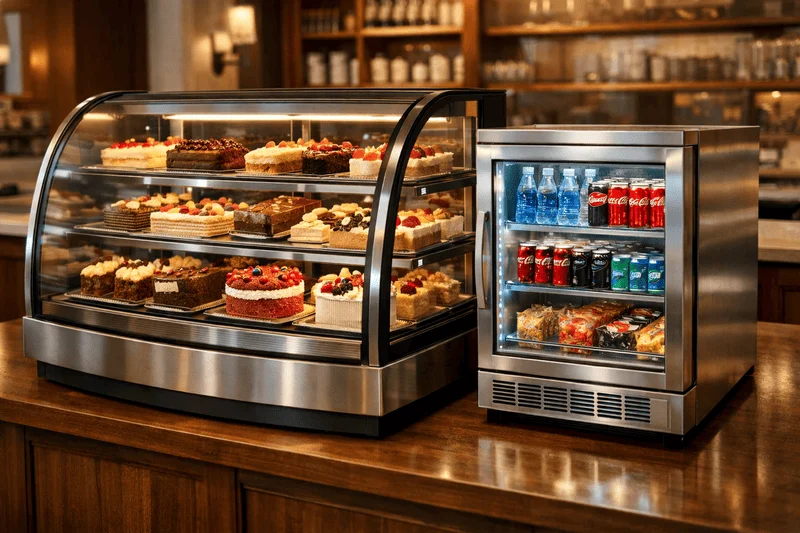
If the product is packaged beverages/snacks, quote a countertop merchandiser refrigerator (glass door, shelves, forced air). If the product is pastries/desserts with frequent door opening and presentation needs, quote a refrigerated display case designed for that category. Choose based on product type, humidity exposure, and merchandising style—not just size.
Dive deeper:
Here’s the fastest decision logic your sales team can use:
- Beverage-driven impulse sales: glass door mini fridge / countertop display fridge
- Dessert presentation: refrigerated bakery display case (often wider, curved glass)
- High traffic grab-and-go: open-air merchandiser (but higher energy, stricter placement needs)
Many distributor catalogs mix these on the same page, so your internal category discipline is your advantage.
What Certifications and Standards Matter for Different Import Markets?
Are you being told “CE is enough” or “NSF is mandatory” without context? The result is rework: new labels, new wiring, and delayed customs clearance.
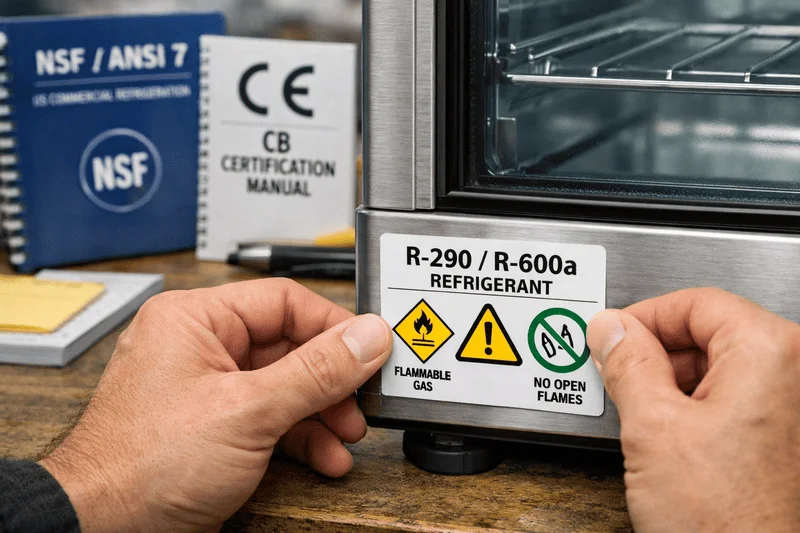
Match certifications to your target sales channel and country: NSF/ANSI 7 is commonly used for commercial refrigeration used to store/display cold food in the U.S.; CE/CB is typical for EU/UK-style compliance paths; and refrigerant safety/handling expectations often reference ASHRAE and ISO safety frameworks for refrigeration systems.
Dive deeper:
Use credible standards references to align internal decisions:
- NSF/ANSI 7 covers commercial refrigerators/freezers used to store and/or display cold food. See Source
- ISO 5149-1 describes safety and environmental requirements for refrigerating systems and heat pumps. See Source
- ASHRAE publishes Standard 15 (refrigeration safety) and Standard 34 (refrigerant designation and safety classification). See Source
- If you’re choosing R-600a / R-290, be prepared to document environmental positioning (and follow safe design/handling). EPA also provides GWP reference tables for refrigerants/substitutes. See Source
For R-600a / R-290 specifically, many industry sources cite it as very low GWP (~3) and ODP 0, which supports sustainability messaging—but compliance still depends on correct design, labeling, and safe manufacturing controls. See Source
How to Compare Suppliers Like a Factory Buyer: RFQ Template and Cost Drivers
Are you receiving quotes that look comparable—until you realize one includes Low-E glass, one uses a different controller, and one has no spare parts plan? That’s not a “price difference.” That’s a different product.
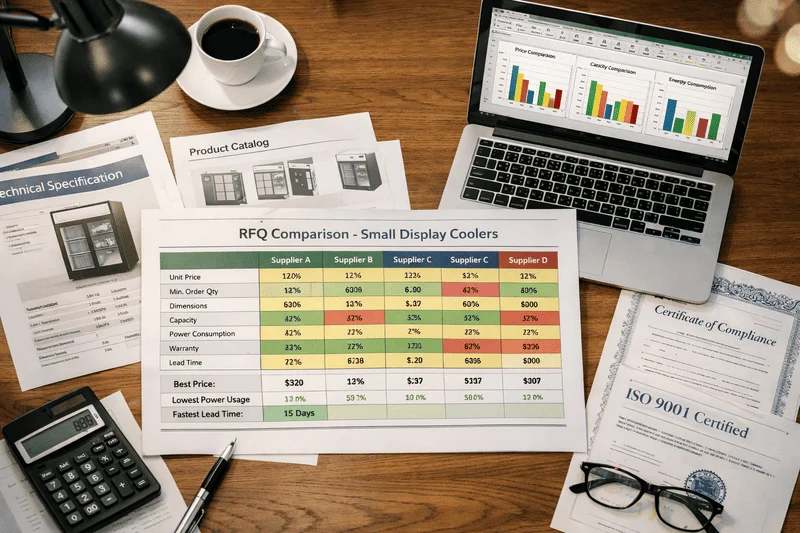
To compare suppliers fairly, standardize your RFQ: define market (voltage/plug + certifications), performance (temperature range + test condition), configuration (shelves, lighting, lock), and export deliverables (packaging, spares, manuals). Then evaluate cost drivers: glass spec, compressor/system design, controller/defrost logic, and certification scope.
Dive deeper:
Below is a practical RFQ skeleton your sourcing team can paste into email and force clean, comparable offers.
RFQ: Small Display Fridge / Countertop Display Refrigerator (OEM/ODM)
Product: Countertop glass door merchandiser refrigerator
Target market: (e.g., USA / EU / UK / Middle East)
Voltage/plug: (e.g., 115 V, NEMA 5-15P / 220–240 V, Schuko/UK)
Temperature range: (e.g., 33–40 °F / 0.5–4.4 °C)
Refrigerant: (e.g., R-134a / R-600a, R-290)
Capacity band: (e.g., 2.5–6.5 cu ft)
Door: swing glass door; lock required (Y/N)
Lighting: LED (top/side), color temperature preference (optional)
Shelves: number + adjustable pitch
Branding: private label / logo position / lightbox (optional)
Certifications: (e.g., CE/CB/ETL/NSF as required)
Packaging: export carton; pallet requirement; drop-test approach
Order plan: trial order + annual forecast; spare parts % and list
Typical cost drivers (so you can negotiate intelligently)
| Cost Driver | What Changes | How You Control It |
|---|---|---|
| Glass spec | single vs double-pane; Low-E | Define minimum; offer “good/better/best” tiers |
| Refrigeration design | compressor class, condenser size | Require stable temp under your load profile |
| Controller & sensors | accuracy, defrost strategy | Standardize controller model across variants |
| Certification scope | lab testing, factory audit | Decide target markets early; avoid midstream changes |
| Packaging | foam density, corner guards | Set a drop-damage KPI and packaging spec |
At KOLVVI, we treat a small commercial display refrigerator like a repeatable export program: spec discipline, certification planning, and service-ready documentation. That is what protects your margin when you scale distribution.
Conclusion
A “small display fridge” is only easy when you define it precisely: category, temperature, refrigerant, voltage/plug, certifications, and export deliverables. Send your target market and capacity band to KOLVVI—we’ll return a factory-ready RFQ and quotation that avoids costly spec mistakes.